Real Estate Septic Inspection
Spokane, WA

Combo Inspection & Pump • SRHD-Approved

$350
Inspection (+ Pumping)
SRHD
Approved Inspector
24–48 Hr
Fast Closing Turnaround

Quick Answer

Spokane Septic Services is an SRHD-approved septic inspector for real estate sales in Spokane and Stevens County, WA. A real estate septic inspection costs $350 plus flat-rate pumping ($750 for a 1,000-gallon tank, $1,100 total). We're approved for Washington's property transfer septic inspection (WAC 246-272A-0270), so your report is transfer-ready. Call (509) 970-9118.

WAC 246-272A-0270 • WA PROPERTY TRANSFER READY

SRHD-Approved for Washington Property Transfer Septic Inspections

Under Washington Administrative Code WAC 246-272A-0270(1)(k), Washington home sellers transferring a property served by an On-Site Sewage System (OSS) must have the septic system inspected by a third-party inspector approved by the local health officer (in Spokane County, the Spokane Regional Health District; Spokane Septic Services is SRHD-approved) and provide official inspection and maintenance records prior to closing.

Why is septic tank pumping required alongside a real estate inspection? Because a full septic tank holds 1,000+ gallons of opaque blackwater sewage that hides structural concrete cracks, root intrusion, broken lower baffles, and partition wall collapse. We perform the complete real estate inspection for $350 plus flat-rate septic tank pumping ($750 for a standard 1,000-gallon tank) in a single visit.

✕ General Home Inspector "Walk-Over" / Dye Test

✕ Never opens buried septic tank lids or pumps the tank

✕ Cannot see submerged concrete fractures, tree roots, or corroded floors

✕ Cannot inspect lower inlet/outlet sanitary tees or effluent filters

✕ Does not measure scum and sludge thickness

✕ Not an SRHD-approved inspector for WAC 246-272A transfer inspections

Risk: $20,000–$40,000 Undiscovered Drainfield Failure
✓ Spokane Septic Full Inspection + Pump-Out

✓ Pre-pump liquid operating level, scum crust & sludge depth audit

✓ Complete 2,000-gal vacuum pump-out & wash-down of both compartments

✓ Bare-wall inspection of concrete, mid-seams, dividing wall & baffles

✓ Drainfield hydraulic backflow test, D-box & lift pump/alarm check

✓ Written inspection report & pumping manifest for Title, Escrow & Lenders

$350 Inspection + Flat-Rate Tank Pumping
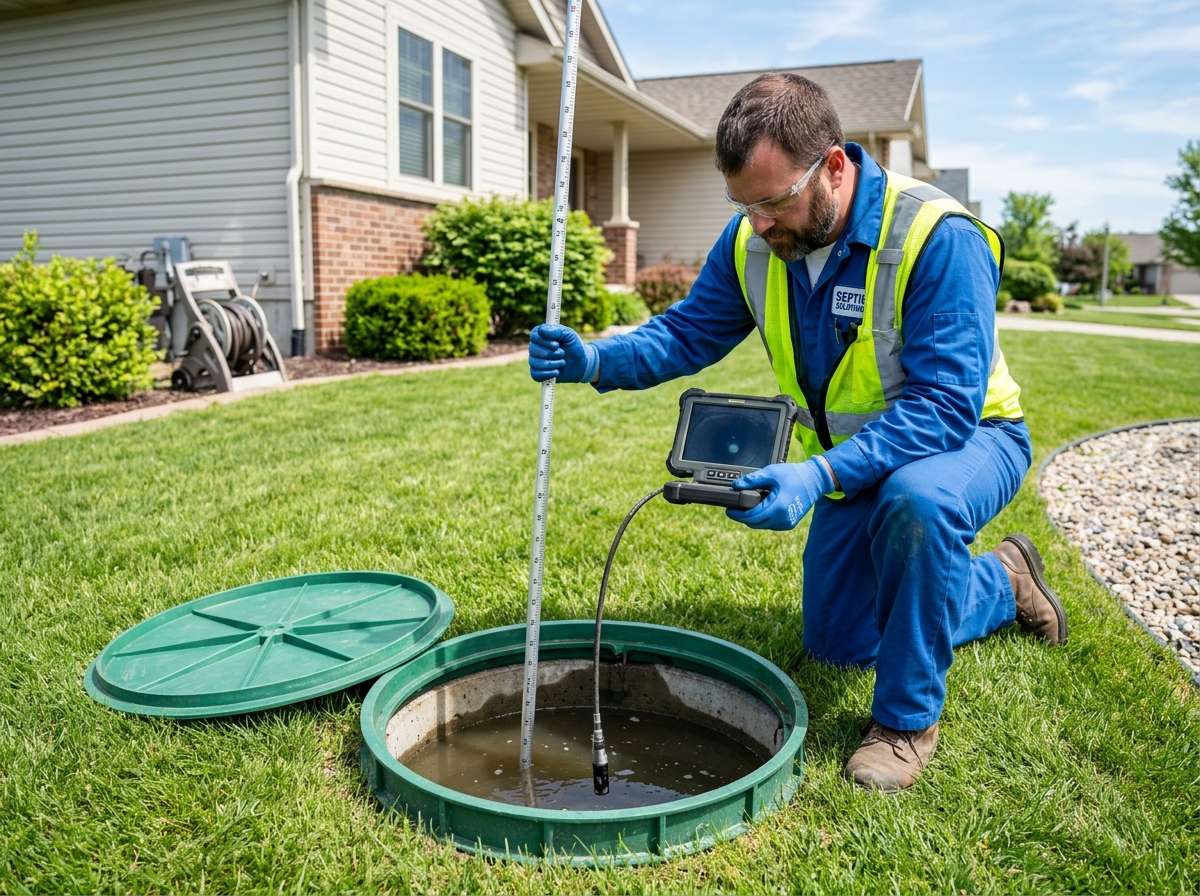
Technician measuring septic tank scum and sludge layers during a Spokane real estate septic inspection

1. Pre-Pump Hydraulic & Sludge Audit

Before pumping a single gallon, we record the static liquid level inside the tank relative to the outlet pipe invert — the #1 indicator of a failing drainfield or leaking tank floor.

  • Static operating liquid level check
  • Floating scum & bottom sludge measurement
  • Industry 1/3 capacity check
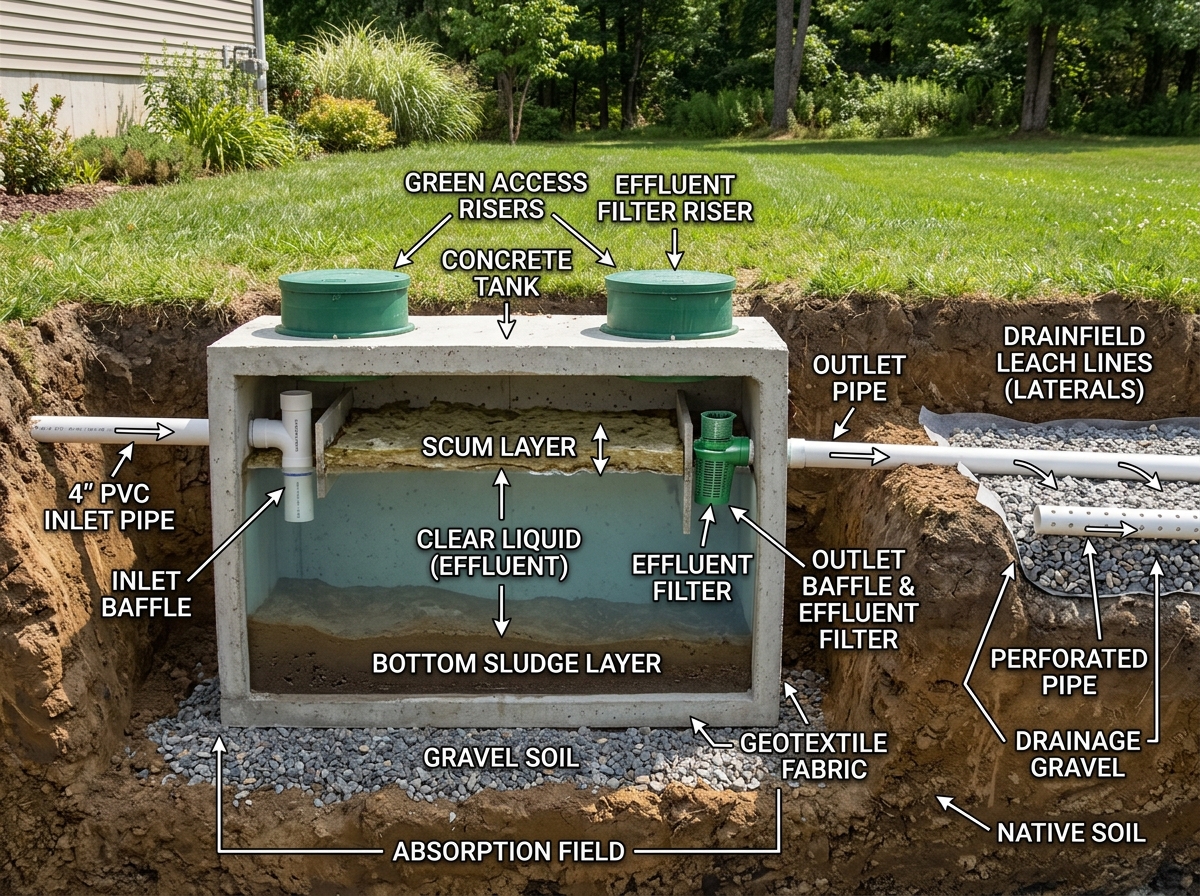
Cutaway diagram of septic tank compartments, baffles, scum, sludge and drainfield

2. Full Pump-Out & Bare-Wall Exam

Our 2,000-gallon vacuum truck pumps both compartments completely dry so our technician can inspect the bare concrete or poly walls, floor, partition wall, and baffles.

  • 100% evacuation of primary & secondary sides
  • Inlet & outlet baffle + effluent filter check
  • Crack, root intrusion & H2S corrosion check
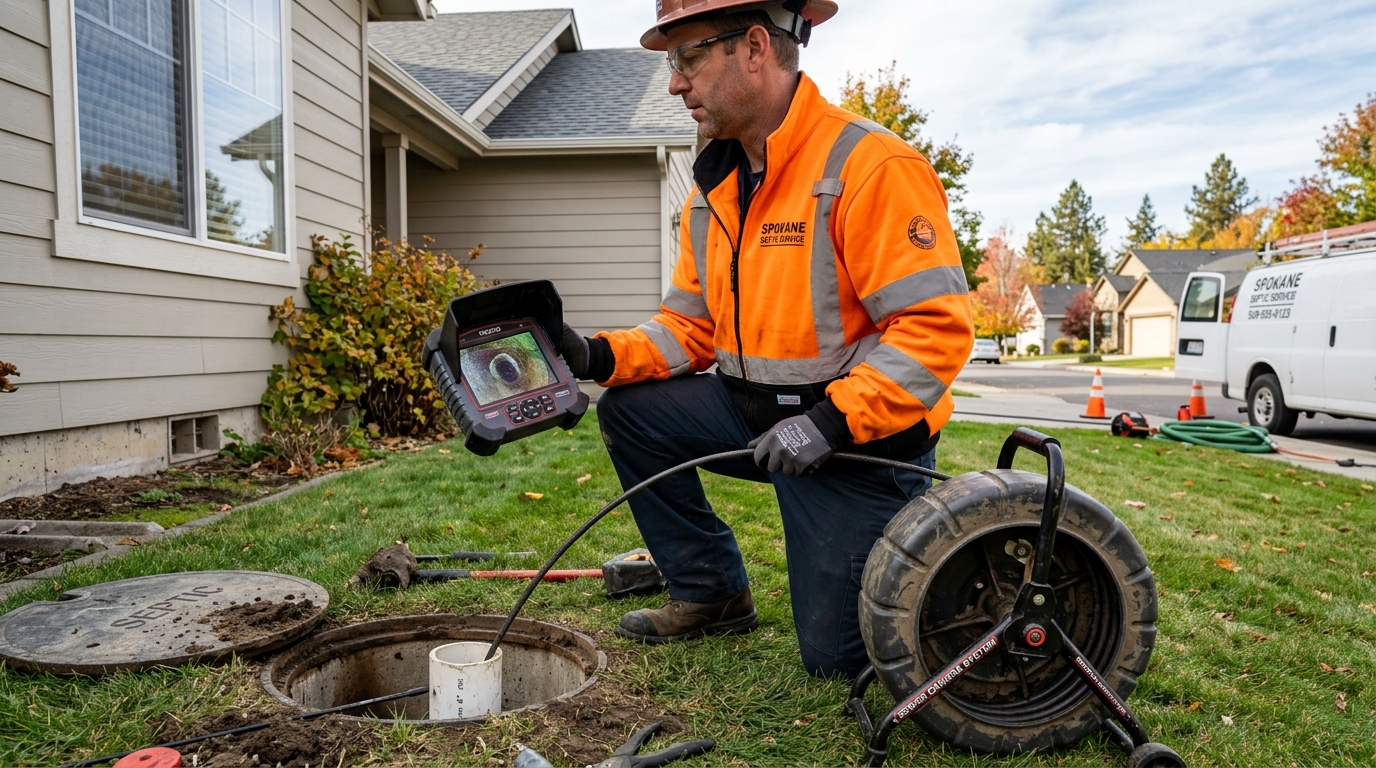
High-definition sewer pipe camera and locating equipment for real estate septic inspections

3. Backflow Check & Escrow Report

With the tank empty, we watch the outlet tee for reverse liquid backflow from the drainfield, test lift-station floats/alarms, and issue your written closing documentation.

  • Drainfield reverse backflow observation
  • Pump chamber floats, check valve & alarm test
  • Written report for buyer, agent & escrow

Real Estate Septic Inspection + Pumping Price Guide

Upfront flat-rate pricing across Spokane & Stevens County. We charge $350 for the real estate inspection plus our standard flat rate to pump the septic tank.

Septic Tank Size / Service Inspection Fee Flat-Rate Pumping Total Combined Flat Rate
Up to 1,000-Gallon Tank (Most 2–3 Bedroom Homes) $350 $750 $1,100 Total
1,250-Gallon Tank (Standard 3–4 Bedroom Homes) $350 $1,000 $1,350 Total
1,500-Gallon Tank (4–5 Bedroom / Larger Homes) $350 $1,250 $1,600 Total
2,000-Gallon Tank (Custom Estates / Multi-Bath) $350 $1,400 $1,750 Total
Standalone Real Estate Inspection (Tank Pumped <12 Mos Ago w/ Receipt) $350 Not Required $350 Total
Optional Escrow Add-Ons (When Bundled w/ Inspection) Mainline Sewer Camera Scope: $150–$350 • 512Hz Electronic Lid Locating: $150–$250 (less when bundled) • Green PVC Riser Upgrade: $250–$450 per lid

Sellers: Have This Ready

A few things make the inspection faster and keep your closing on schedule:

Questions before you book? Call (509) 970-9118.

Washington State Real Estate Septic Laws: WAC 246-272A-0270 Property Transfer Inspections, RCW 64.06 & NWMLS Form 22S

Buying or selling a home with an On-Site Sewage System (OSS) in Spokane County or Stevens County is governed by overlapping state public health statutes, county health district regulations, and real estate contract law. Understanding these rules protects sellers from post-closing legal liability and protects buyers from inheriting a $25,000 to $45,000 drainfield replacement.

1. Washington's Property Transfer Septic Inspection Rule (WAC 246-272A-0270)

The Washington State Board of Health adopted comprehensive revisions to Chapter 246-272A WAC (On-Site Sewage Systems). Under WAC 246-272A-0270(1)(k), every property owner selling or transferring real property served by a septic system in Washington State must comply with three legal mandates prior to property transfer:

2. NWMLS Form 22S (Septic Addendum) in Spokane Home Sales

Most residential purchase agreements in Washington that involve a septic system include the Northwest Multiple Listing Service (NWMLS) Form 22S Septic Addendum. It spells out who orders the septic inspection and pumping, the timeline, and what happens if problems are found. Terms vary by contract, so confirm the details with your real estate agent.

Official sources: WAC 246-272A-0270 (Washington State Legislature) • SRHD On-Site Sewage (Septic) Systems

Why Pumping Is Needed for a Real Structural Inspection:
WAC 246-272A-0270 requires pumping when solids and scum levels show it's needed; the common industry guideline is when combined scum and sludge reach about one-third of the liquid depth. More importantly, during a real estate sale, you cannot inspect the lower 4 to 5 feet of a concrete tank while it is full of opaque sewage. Pumping the tank completely dry with our 2,000-gallon vacuum truck is the only way to verify that the tank floor is not leaking groundwater, the center dividing wall has not separated, and the lower outlet tee has not rotted off.

What We Inspect: 9-Component Real Estate Septic Inspection

Every $350 real estate septic inspection + pump-out covers these 9 system components, and the results are submitted to the Spokane Regional Health District (SRHD).

System Component What We Measure & Inspect What a Healthy System Looks Like Failure / Red Flag Indicators
1. As-Built Verification & Setbacks Compare physical tank & drainfield location against SRHD historical "as-built" drawing; check surface grading, driveways, structures, and trees over the system. No buildings, unapproved paving, livestock, or deep-rooted trees over the tank, reserve area, or drainfield trenches. Patios/sheds built over drainfield; driveway traffic crushing laterals; undocumented tank modifications.
2. Access Lids & Risers Inspect both primary (inlet) and secondary (outlet) compartment access covers, concrete lids, and green PVC risers for watertight seal and child-safety locks. Risers must be watertight to prevent surface runoff infiltration and secured with stainless screws or tamper-resistant locks. Crumbling concrete lids (rebar exposed); unsealed riser joints leaking snowmelt; missing safety bolts.
3. Pre-Pump Static Liquid Level Observe the undisturbed liquid line relative to the bottom invert of the outlet pipe before any pumping occurs. Operating liquid level must sit precisely at the bottom invert of the outlet tee — never above or below it. High water mark above outlet: Drainfield is backing up into the tank.
Low water level: Tank bottom is cracked and leaking raw sewage into soil.
4. Scum & Sludge Core Profile Measure floating scum mat thickness (fats/oils/grease) and settled bottom sludge depth in both compartments prior to pump-out. Industry guideline: pump before combined scum + sludge reach about 1/3 of liquid depth. Sludge overflowing past the outlet tee directly into the drainfield (causes irreversible soil biomat clogging).
5. Inlet & Outlet Baffles / Sanitary Tees Inspect concrete cast-in-place baffles or Schedule 40 PVC sanitary tees on both the house inlet and drainfield outlet pipes. Inlet baffle must direct incoming sewage downward; outlet baffle must trap floating scum while discharging only clarified middle-zone effluent. Hydrogen sulfide (H2S) gas rot eating away concrete baffles; detached PVC tees lying at the bottom of the tank.
6. Effluent Filter Cartridge Pull, hose down, and inspect the outlet effluent screen (Polylok, Tuf-Tite, or Zabel filter) for biomat plugging or bypass. Filter must seat tightly in the outlet tee housing and block solids >1/16" to 1/8" from entering the soil absorption system. Completely plugged filter causing sewage backup into the house, or missing filter allowing solids into the drainfield.
7. Post-Pump Bare Tank Structure & Dividing Wall After pumping 100% of waste and rinsing walls, inspect all four walls, floor slab, mid-seam joint, and the internal compartment partition wall. Tank must be 100% watertight (concrete, fiberglass, or polyethylene) with intact structural integrity and no groundwater seepage. Structural shear cracks; groundwater streaming in through mid-tank seam; willow/pine roots penetrating pipe penetrations.
8. Drainfield Hydraulic Backflow & D-Box Observe the empty outlet pipe after pumping to verify zero reverse flow from the distribution box (D-box) and inspect the drainfield surface for ponding or odors. Effluent must flow freely away from the tank with equal distribution across all absorption trenches and zero surface breakout. Water running backward from the outlet pipe into the empty tank; spongy grass, lush stripes, or sewage odor in yard.
9. Pump Chamber, Floats & High-Water Alarm (For pressure distribution, mound, or sand-filter systems) Test the effluent pump amperage/drawdown, check valve, control floats, and audible/visual high-water alarm. Pump must cycle at the designed dose volume; high-water alarm must trigger independently on a separate electrical circuit. Seized effluent pump, tangled mercury/mechanical float switches, failed check valve siphoning back, or dead alarm panel.
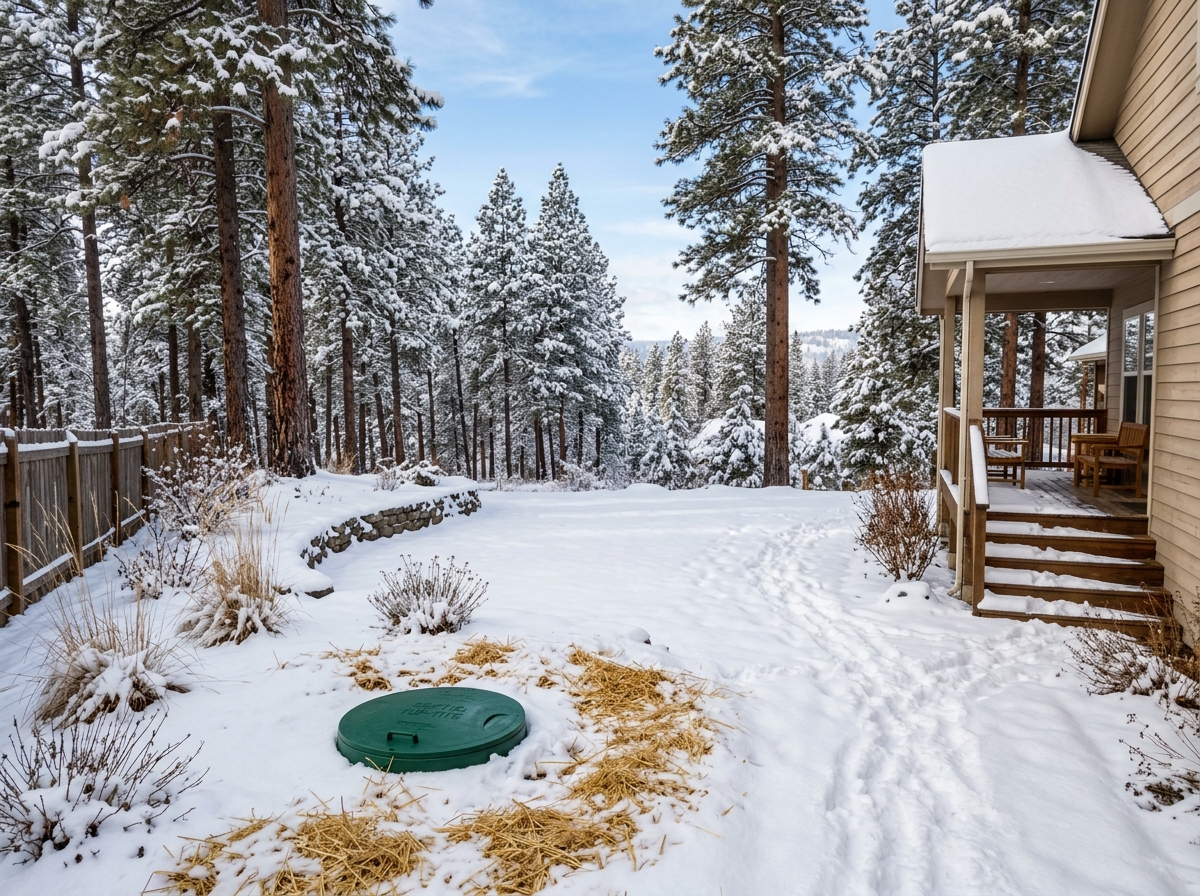
Spokane winter septic inspection and buried septic tank locating

Buried Lids, Winter Closings & Mainline Camera Scopes

Seller Doesn't Know Where the Tank Is? In older Spokane neighborhoods (South Hill, Five Mile, Mead, Spokane Valley, and Deer Park), septic lids are frequently buried 1 to 4 feet underground beneath sod, landscaping, or snow. We pull the official SRHD as-built map and flush a 512Hz electronic sonde transmitter to pinpoint the exact lid coordinates before digging a single shovel of dirt.

Protect Yourself from Hidden Pipe Defects: While our team has the tank open, you can add a full HD Sewer Camera Inspection ($150–$350) of the building sewer line from the house to the tank to verify there are no crushed pipes, offset joints, or root blockages hiding under the lawn.

Common Real Estate Septic Inspection Findings in Spokane County (And How We Fix Them Before Closing)

Homeowners and real estate agents often worry that a septic inspection will uncover a catastrophic problem that kills the sale. In our experience, most deficiencies found during a real estate septic inspection are repairable tank-side issues — not failed drainfields. Because Spokane Septic Services arrives with a 2,000-gallon vacuum truck, 4,000 PSI hydro-jetter, HD sewer camera, and replacement baffles/risers on the truck, we can resolve most common escrow flags during the same appointment:

Spokane & Stevens County Real Estate Inspection Service Areas & ZIP Codes

Every town in Spokane County and South Stevens County has distinct soil profiles, water-table depths, and system types that we evaluate during a home-sale septic inspection:

City / Service Hub Covered ZIP Codes Common Local Septic System Types & Escrow Considerations
Spokane (North Side & South Hill) 99208, 99223, 99224, 99203, 99205, 99207, 99217, 99218, 99201 1950s–1980s concrete gravity tanks in Five Mile Prairie, Indian Trail, Moran Prairie, and Glenrose; frequent deeply buried lids, H2S concrete baffle rot, and tree root intrusion.
Spokane Valley, Greenacres & Veradale 99206, 99216, 99212, 99016, 99037 Fast-draining glacial gravel soils over the Spokane Valley–Rathdrum Prairie Aquifer; older concrete tanks, drywells/cesspools requiring disclosure, and sewer connection proximity checks.
Liberty Lake 99019 Acreage estates, rocky hillside pressure-distribution systems, and older lake-corridor properties requiring strict watertight tank and outlet filter verification.
Newman Lake & Otis Orchards 99025, 99027 High seasonal water tables, shoreline mound/sand-filter systems, pump chambers with dual floats/alarms, and rural 5–10 acre equestrian parcels.
Deer Park, Chattaroy, Clayton & Loon Lake 99006, 99003, 99009, 99110, 99148 Deep winter frost lines along the Hwy 395 corridor, sandy loam and clay hardpan transitions, long building sewer runs, and lake cabin holding or pressure systems.
Mead, Colbert & Green Bluff 99021, 99005 1,250 to 2,000-gallon multi-compartment tanks, pressurized mound systems on clay/silt bench soils, and deep buried lids requiring 512Hz electronic locating.
Cheney, Medical Lake, Airway Heights & Spangle 99004, 99022, 99001, 99014, 99031 Shallow fractured basalt bedrock across the West Plains requiring shallow trench, pressure-dosed, or mounded drainfields and freeze-protected piping.
Nine Mile Falls, Suncrest & Tumtum 99026, 99034 Sloped Spokane River & Long Lake canyon terrain, sandy pine soils, ponderosa pine root intrusion at tank inlets, and 150–200+ ft hose access runs.

Real Estate Septic Inspection Service Areas

Spokane Septic Main Hub Spokane (99208, 99223, 99224, 99203) Spokane Valley (99206, 99216, 99016, 99037) Liberty Lake (99019) Newman Lake & Otis Orchards (99025, 99027) Deer Park & Loon Lake (99006, 99148) Mead & Colbert (99021, 99005) Cheney & Medical Lake (99004, 99022, 99001) Nine Mile Falls & Suncrest (99026)

Real Estate Septic Inspection FAQ

How much does a real estate septic inspection cost in Spokane?
Our certified real estate septic inspection is a flat rate of $350, plus our standard flat rate for septic tank pumping ($750 for a 1,000-gallon tank, $1,000 for 1,250-gallon, $1,250 for 1,500-gallon, or $1,400 for 2,000-gallon). For a standard 1,000-gallon residential tank, your combined total for both the inspection and complete pump-out is $1,100 flat with zero hidden mileage fees.
What is Washington's property transfer septic inspection rule?
Under Washington Administrative Code WAC 246-272A-0270(1)(k), every property owner selling or transferring real estate served by an on-site sewage system (OSS) in Washington State must obtain a septic system inspection from a third-party inspector approved by the local health officer prior to property transfer, submit the inspection report to the local health jurisdiction (Spokane Regional Health District), and provide maintenance records to the buyer alongside the RCW 64.06 seller disclosure statement.
Why does the septic tank have to be pumped during a real estate inspection?
A full septic tank holds 1,000 to 2,000 gallons of opaque blackwater sewage and floating scum, hiding most of the tank's interior. Pumping the tank dry is the only way to inspect the submerged concrete walls, floor, mid-tank seam, compartment partition wall, and lower inlet/outlet baffles for cracks, root intrusion, or structural collapse. Most Washington purchase agreements also include NWMLS Form 22S (Septic Addendum), which covers septic inspection and pumping; confirm the terms of your contract with your agent.
Who pays for the septic inspection and pumping in a Washington home sale — buyer or seller?
It's negotiable and set by your purchase agreement (often NWMLS Form 22S). In many Spokane sales the seller pays to have the septic tank pumped and inspected prior to closing and delivers the inspection report and pumping receipt to the buyer. However, buyers may also order an independent pre-purchase septic and sewer camera inspection during their inspection contingency period.
When does a septic tank need to be pumped?
WAC 246-272A-0270 requires owners to pump when solids and scum levels show it's needed. The common industry and EPA guideline is to pump when the combined thickness of the floating scum layer and settled bottom sludge layer exceeds one-third (1/3 or 33%) of the total liquid depth of the tank, or when the bottom of the scum layer is within 3 inches of the bottom of the outlet baffle, or the top of the sludge layer is within 8 inches of the outlet tee.
What's included in your written septic inspection report?
Our written report and pumping receipt document tank size, pre-pump liquid level, scum and sludge levels, baffle and filter condition, structural condition, and drainfield observations: the information buyers, agents, lenders, and escrow typically ask for. As an SRHD-approved inspector, we submit the inspection to the Spokane Regional Health District.
What is the difference between a general home inspector and a professional septic inspection?
A general home inspector only walks over the yard and runs faucets inside the house — they do not excavate lids, measure sludge depth, pump the tank, inspect baffles, or check for drainfield backflow. Under WAC 246-272A-0270, the transfer inspection must be done by an inspector approved by the local health officer. In Spokane County, that means an SRHD-approved inspector like Spokane Septic Services.
What if the septic tank lids are buried underground and the seller doesn't know where they are?
We pull historical as-built diagrams from the Spokane Regional Health District (SRHD) and use our 512Hz electronic sonde transmitter and Ridgid NaviTrack Scout receiver to pinpoint the exact location and depth of buried lids before digging. We can also install ground-level green PVC risers during the visit so the new homeowner never has to dig again.
What happens if a real estate septic inspection finds a broken baffle or minor defect?
Most real estate septic defects are minor tank-side issues — such as a deteriorated concrete outlet baffle, missing effluent filter, cracked concrete lid, or failed lift-station float switch — rather than a failed drainfield. Because our crew is already on-site with an empty tank, we can often replace a baffle, install a riser, or hydro-jet a root-blocked line on the spot so your closing stays on schedule.
How fast can you schedule a real estate septic inspection for an upcoming closing?
We prioritize time-sensitive real estate escrow deadlines and can typically be on-site within 24 to 48 hours anywhere in Spokane County or Stevens County, with your written inspection report and pumping receipt delivered immediately upon completion. Call (509) 970-9118 to schedule.

Need a Real Estate Septic Inspection for Closing?

$350 Flat-Rate Inspection + Flat-Rate Tank Pumping • SRHD-Approved Inspector • Call (509) 970-9118

Schedule Inspection (509) 970-9118